

Up until fairly recently, cars were primarily mechanical and electronic. Today, just as the mobile phone has become a platform for software, cars are becoming increasingly connected, with significantly more software than in the past. By 2030, 2.5 billion vehicles—or about 95% of new vehicles sold globally—will be software-laden, connected cars.
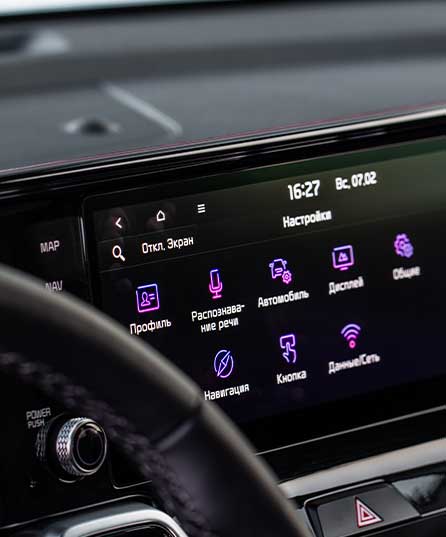
Software is dramatically changing the in-car experience, especially as driving becomes increasingly autonomous. A car’s styling and exteriors will continue to define the brand, but the in-car experience is becoming increasingly important for differentiation. The vehicle must engage both the passenger and the person who is driving.
Many users expect a fully customizable in-car experience. They want an infotainment system that integrates directly with their mobile phone and receives updates just as quickly. Most OEMs are releasing or have declared roadmaps for software-defined cars in which every feature is configurable.
Before cars were connected, vehicle owners had to take the car to a service engineer when they needed a software update. With an older, primarily mechanical car, service could take place at six-month intervals. But the features of a connected vehicle, as well as electrification and autonomous driving, increasingly rely on complex software. More than 100 million lines of code may be distributed across the car, which must be updated regularly due to its complicated and buggy nature. But driving your vehicle to the dealership daily to update its software is impractical.
The ability of any OEM to deliver an engaging, up-to-date in-car experience and remain competitive in a connected automotive ecosystem is entirely dependent on an effective platform for providing over-the-air (OTA) updates to every one of their vehicles on the road. OTA updates, delivered securely, efficiently, and quickly via the cloud, will soon be the defining feature of connected cars. Automakers have started to realize the importance of OTA being their main digital revenue channel, shifting to services-based revenue models.
There is a great need for secure, robust OTA strategies in the automotive market. Some OEMs’ seems to be ahead of the pack in this area, yet their network appears vulnerable to hacks. But consumers are serious about their desire for quick, safe updates and configurable services throughout the vehicle. Connected cars are taking over the automotive market, and OTA capability is not only vitally important but it’s also inevitable.
Several key challenges remain to overcome, including download and installation time impacts, types of results ranging from full to delta installations, and managing clean rollbacks in the event of failures. The extent of implementation is also dependent on the underlying vehicle (E/E) architecture. Within architectures, there is an emergence of service-oriented E/E architecture, a fast migration from current ECU-based to domain controller-based architectures. Future OTA solutions should be able to orchestrate and prioritize crucial updates across millions of cars with diverse E/E architectures worldwide. Solution providers should also consider providing OTA campaigns that identify optimal (time) windows for download, even during a commute. As OEMs are charged for data usage, solutions also need to minimize the payload efficiently.
There is also a need for standardized interfaces that facilitate communications between components and the cloud so that OEMs can communicate and manage warranty recalls more effectively. This push for standardization is primarily driven by continuous integration or continuous delivery (CI/CD) pipelines and validation and verification (V&V) trends. One example of an effective, industry-wide integration collaboration is the eSync Alliance, whose V2.0 standard was released in 2021.
Quest Global is an industry leader in infotainment systems and the integration of OTA solutions. Our global teams of engineers have a proven track record of developing and integrating effective solutions that leverage the latest automotive technology to transform the in-car experience for drivers and passengers alike.
We are an ideal partner for OEMs seeking to integrate fast, secure OTA solutions that users trust. Quest Global has strategically established centers of excellence in key geographies around the globe, allowing our clients access to a local team equipped with international resources and expertise. We provide valuable partnerships and support as companies navigate the changing ecosystem of software-defined cars, vehicle connectivity, and over-the-air (OTA) updates.










Rajkin G
Rajkin G is the Director of Technology- Automotive at Quest Global. Rajkin G is a dynamic leader that specializes in building and making things work across various domains. It includes strategy, technical sales, incubation, and delivery leadership in software and embedded product engineering for automotive, medical, and high-tech industries. Starting his career as a software engineer with Quest Global in 1997, Rajkin has grown through the ranks by developing innovative engineering solutions and leading teams across multiple verticals, including semiconductor, broadband, and supply chain, primarily for North American clients. In 2004, he transitioned to the medical devices sector, where he played a pivotal role in establishing and expanding the medical practice within Quest Global. Under his leadership, the team built the largest offshore development center for a Tier-1 medical OEM from the ground up. Rajkin has held various key positions, managing critical programs both onsite and offshore, and continues to be a part of the senior management team, providing strategic advice for the account and regional growth. In 2010, he took on the challenge of diversifying and developing new accounts in Europe and North America, leading pre-sales, business development, and marketing efforts alongside operations. With over twenty years of industry experience, Rajkin currently heads the delivery for the medical devices vertical globally, focusing on incubating new accounts within the practice. In 2018, he ventured into the automotive sector, working with OEMs and Tier-1 suppliers on infotainment and ADAS solutions.
Frequently Asked Questions
Implementing Over-the-Air (OTA) updates offers automotive OEMs several strategic advantages. Firstly, it allows OEMs to continuously enhance the in-car experience by updating software without requiring physical vehicle recalls. This not only saves costs but also ensures that vehicles remain competitive as they align with the latest technological advancements. Additionally, OTA updates enable OEMs to establish a service-based revenue model, offering premium features or updates for a fee. This model can significantly boost revenue streams. Furthermore, OTA capabilities enhance brand loyalty by ensuring vehicles are consistently updated with the latest safety protocols and features, which is crucial in the highly competitive automotive market.
Deploying OTA updates in connected vehicles presents several challenges, including managing download and installation times, ensuring secure data transmission, and handling potential failures during updates. These challenges can be addressed by developing robust OTA strategies that prioritize secure and efficient data handling. Solutions should incorporate service-oriented E/E architectures that enable flexible update scheduling and management. Additionally, employing standardized interfaces can facilitate better communication between vehicle components and the cloud, aiding in efficient update rollouts. Collaboration with industry alliances like the eSync Alliance can also help standardize and streamline OTA processes.
Standardization and industry collaborations are crucial in advancing OTA technologies as they foster interoperability and compatibility across different OEMs and suppliers. Standardized interfaces and protocols ensure that OTA solutions can be integrated seamlessly into various vehicle architectures, enhancing the scalability and efficiency of updates. Collaborations, such as those with the eSync Alliance, drive the development of industry-wide standards, promoting innovation and reducing development costs. These efforts ensure that OTA technologies remain robust, secure, and capable of addressing the evolving needs of the connected automotive ecosystem.
Quest Global differentiates our integration of OTA solutions through extensive expertise in engineering and its strategic global presence. By leveraging a team of globally distributed engineers, Quest Global offers localized support with international expertise, ensuring seamless integration of OTA solutions. Our company’s proactive approach in developing and integrating cutting-edge solutions enhances the in-car experience for both drivers and passengers. Quest Global’s commitment to innovation and its partnerships with leading technology companies further solidify our position as a trusted partner for OEMs aiming to implement fast, secure, and efficient OTA solutions.
The transition from ECU-based to domain controller-based architectures significantly impacts OTA solutions by enabling more streamlined and efficient update processes. Domain controller-based architectures centralize control functions, reducing the complexity and number of ECUs required. This centralization allows for more efficient software updates as fewer components need to be individually addressed. Moreover, domain controllers can more effectively manage service-oriented architectures, which are essential for orchestrating and prioritizing OTA updates across diverse vehicle models. This transition supports the scalability and flexibility needed for future OTA solutions, enhancing their ability to deliver timely and comprehensive updates.