

The medical imaging industry stands at a transformative junction where Artificial Intelligence (AI) reshapes traditional paradigms of diagnostic capabilities, operational workflows, and device utilization. With approximately 60-70% of FDA-approved AI applications concentrated in medical imaging, the sector leads healthcare’s AI adoption curve. This technological evolution demands a sophisticated engineering approach that balances innovation with regulatory compliance, system integration, and cost optimization.
AI Integration for Enhanced Diagnostic Quality
The primary engineering challenge in AI-enhanced diagnostic imaging lies in developing robust algorithms that maintain consistent accuracy across diverse clinical scenarios. Modern imaging systems must process and analyze complex datasets while adhering to stringent safety and regulatory requirements. The engineering scope extends beyond image enhancement into sophisticated real-time processing frameworks that provide immediate diagnostic feedback to clinicians.
Integration of AI models with existing clinical workflow platforms represents a crucial technical hurdle. Engineering teams must develop validation frameworks that ensure consistent performance across varied patient populations while managing the critical aspect of false positives through sophisticated confidence scoring mechanisms. These scoring systems must adapt to different clinical contexts and maintain high accuracy across diverse diagnostic scenarios.
A significant engineering advancement in this domain enables superior image quality with more economical hardware specifications. AI-enhanced reconstruction algorithms now compensate for lower-specification components, fundamentally changing the cost-quality equation in imaging system design. This breakthrough allows manufacturers to develop compact, cost-effective systems without sacrificing diagnostic quality, making advanced imaging more accessible to healthcare providers.
Workflow Optimization in Connected Imaging Environments
The second pillar of AI application centers on workflow optimization, demanding sophisticated system integration capabilities. Modern imaging solutions must create seamless interfaces between Electronic Medical Record (EMR) systems, Picture Archiving and Communication Systems (PACS), Radiology Information Systems (RIS), and Clinical Decision Support Systems. This integration challenge requires robust interoperability frameworks that facilitate smooth data exchange across multiple platforms.
Real-time synchronization of patient information forms the backbone of these connected systems. Engineers must develop automated workflow routing mechanisms based on clinical priorities while ensuring standardized integration protocols function reliably in multi-vendor environments. These protocols must maintain data integrity and security while enabling rapid access to critical diagnostic information.
Operational Efficiency Through Device Utilization
The third critical aspect involves optimizing device utilization through AI-driven operational intelligence. Predictive maintenance algorithms now form the cornerstone of modern imaging systems, continuously monitoring performance parameters and predicting potential issues before they affect clinical operations. Load balancing systems work in concert with these predictive capabilities to maximize equipment utilization across healthcare facilities.
The development of variable cost productivity models marks a significant engineering breakthrough in operational efficiency. These sophisticated models optimize hardware specifications based on specific clinical requirements while reducing total ownership costs through AI-enhanced capabilities. The integration with asset management systems enables improved lifecycle management and enhanced service prediction, creating a more sustainable operational model for healthcare providers.
Evolving From Individual Devices to Integrated Solutions
The progression of healthcare desvice development, specifically medical imaging systems, requires a fundamental shift in engineering approach. Traditional approach to develop medical devices centered focusing primarily on core functions like X-ray capture or image processing. These systems were designed with limited consideration for broader healthcare workflows, operating in technological silos where connectivity meant simple data transfer to archives or electronic medical records. This device-centric engineering model, while functional, created fragmented healthcare experiences and operational inefficiencies.
Modern system design demands a radical shift in perspective – beginning with understanding where imaging devices fit within the complete patient care journey. This patient-centric approach recognizes that imaging devices never exists in isolation but forms part of a complex diagnostic and treatment cycle. A physician first examines the patient, determines the need for imaging, orders specific tests, and uses the results to guide treatment decisions. This cycle may repeat multiple times throughout the patient’s care journey. Engineers must now design systems that support this entire clinical workflow, incorporating sophisticated connectivity architectures that enable seamless information flow between care providers, diagnostic systems, and treatment planning tools.
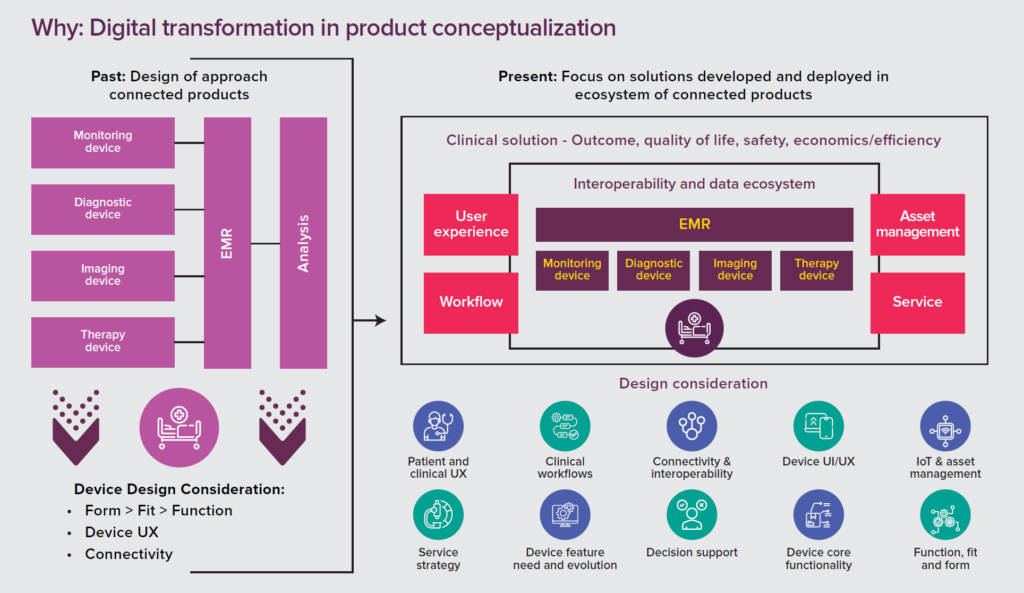
The economic realities of modern healthcare further reinforce the need for integrated solutions. Healthcare providers, particularly in the U.S. and Europe, increasingly operate under bundled payment models where reimbursement covers complete episodes of care rather than individual diagnostic procedures. This financial structure demands imaging solutions that optimize both clinical workflows and resource utilization. Data management strategies must evolve beyond simple storage and retrieval to enable sophisticated asset management, predictive maintenance, and intelligent scheduling – ensuring maximum equipment availability when needed while maintaining cost efficiency. These considerations, previously treated as secondary factors, now become primary design requirements that shape how imaging systems integrate into the broader healthcare ecosystem.
Engineering Partnerships To Deliver Integrated Solutions
As medical imaging OEMs navigate these complex engineering challenges, selecting the right engineering partner becomes crucial. Quest Global, has significant proven capabilities in digital health, having worked with top players in the space to develop some of the most adopted platforms today. In addition, Quest Global, offers distinct value through Silicon to Systems to Cloud (S2SC) expertise. The company’s engineering teams develop custom SOC/ASIC designs that optimize imaging performance while enabling seamless integration of AI capabilities across the imaging pipeline.
Quest Global bridges a critical gap between custom silicon requirements and system integration, ensuring medical imaging manufacturers can access specialized semiconductor solutions despite relatively lower volume requirements compared to other industries. This capability proves particularly valuable as manufacturers seek to optimize their hardware specifications without compromising on digital capabilities or performance.
The future of medical imaging lies in seamless AI integration across diagnostic quality, workflow optimization, and operational efficiency. Success demands technological expertise and an engineering approach addressing regulatory compliance, system integration, and cost optimization. Strategic partnerships with experienced engineering service providers remain essential for maintaining a competitive advantage while delivering superior clinical outcomes.










Amjad Jabbar
Amjad Jabbar is the Vice President of Digital Health at Quest Global, bringing over 25+ years of global experience in healthcare product development, engineering services, and digital transformation. He has led the development of complex, high-tech, and regulated medical devices and healthcare digital solutions throughout their entire lifecycle. Amjad is known for spearheading key projects that use cutting-edge technologies, particularly in the application of artificial intelligence and data analytics, to enhance patient outcomes and streamline healthcare processes. At Quest Global, Amjad focuses on strategic business growth in healthcare engineering services, leveraging his unique blend of sales acumen and deep domain expertise. His specialties include – Digital health, SAFe, , DevOps, DevSecOps, CI/CD, Medical Devices, AI / ML, and more. Prior to joining Quest Global, he worked as the Executive Director - Technology Operations at GE Healthcare.
Frequently Asked Questions
AI significantly improves diagnostic quality by employing advanced algorithms that ensure high accuracy across diverse clinical scenarios. These algorithms process complex datasets to provide immediate feedback to clinicians, enhancing diagnostic precision. AI models are integrated with existing clinical workflows to maintain performance consistency across various patient populations. Furthermore, innovations in AI have enabled imaging systems to deliver superior image quality even with more economical hardware, making advanced diagnostics accessible without compromising on quality.
AI-driven workflow optimization enhances operational efficiency by creating seamless interfaces between various healthcare systems, ensuring real-time synchronization of patient data. Automated workflow routing mechanisms based on clinical priorities improve the speed and accuracy of diagnostics. Predictive maintenance algorithms and load balancing systems maximize equipment utilization, leading to cost savings and improved service delivery. These optimizations allow healthcare providers to offer faster, more reliable diagnostics while managing resources effectively.
Quest Global contributes to the evolution of medical imaging systems through its Silicon to Systems to Cloud (S2SC) expertise. Our company develops custom SOC/ASIC designs that enhance imaging performance and facilitate AI integration. Quest Global’s engineering teams offer tailored solutions that address regulatory compliance, system integration, and cost optimization. Our partnership approach ensures that medical imaging manufacturers can deliver advanced, patient-centric solutions that meet the modern healthcare industry’s demands.
Integrating AI into medical imaging involves several engineering challenges, including the development of robust validation frameworks and seamless system integration. Engineers must ensure that AI models consistently perform well across different patient demographics and clinical contexts. Another critical challenge is creating interoperability frameworks that allow smooth data exchange between disparate systems like EMR, PACS, and RIS. Additionally, maintaining data integrity and security while enabling real-time synchronization of patient information is essential.
Strategic partnerships are crucial in advancing AI-integrated medical imaging solutions as they provide access to specialized expertise and resources. For instance, Quest Global offers comprehensive engineering services that bridge the gap between custom silicon requirements and system integration. These partnerships enable medical imaging manufacturers to optimize hardware specifications and integrate AI capabilities seamlessly across the imaging pipeline. Collaborations with experienced engineering service providers ensure adherence to regulatory compliance and cost optimization, maintaining a competitive edge.