

Introduction
The urgency to mitigate global warming, predominantly driven by Greenhouse Gas (GHG) emissions, has accelerated the search for sustainable aviation fuels (SAFs). The aviation industry, notorious for being a major GHG contributor and inefficient fossil fuel consumer, is a core area for intervention. At Quest Global, propelled by the global agenda for a greener future, we have been actively engaged in innovative research to discover sustainable fuel alternatives for aviation and beyond.
Quest Global is at the forefront of pioneering research and development aimed at realizing the ambitious goal of net-zero carbon emissions by 2050, in line with the Paris Climate Accord. Focusing on the aviation sector, our engineers have identified vast potential for substantial emissions reduction. This article illustrates our exploratory journey into developing a viable Sustainable Aviation Fuel (SAF) alternative—blended hydrogen fuel. Through meticulous simulations and proof of concept (PoC) tests, we unveil the promising prospects and challenges of employing hydrogen as a key component of SAF.
Alternative aviation fuel landscape
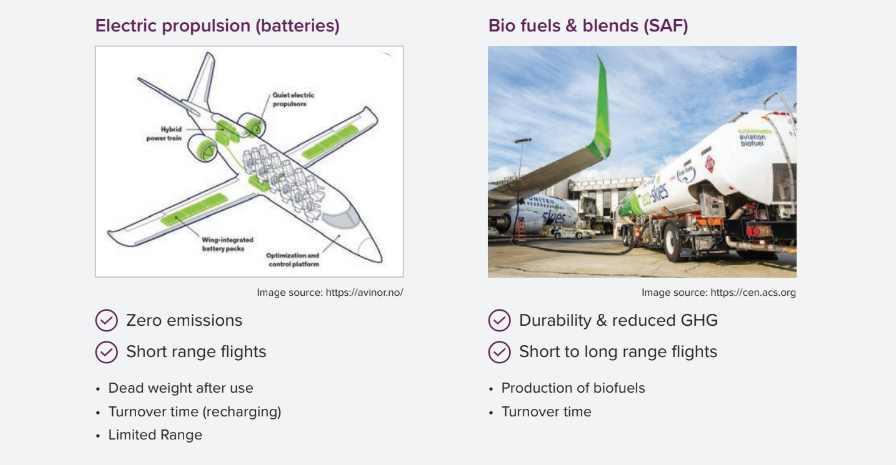
The search for reducing the aviation sector’s carbon footprint has led to the exploration of multiple fuel alternatives, each at varying stages of development, testing, and adoption. Among these, electric propulsion and biofuels and blends (SAF) have shown promise yet come with their own set of challenges. Electric batteries, although offering zero emissions, are constrained by limited range and recharging turnover time, making them suitable only for short-range flights. Batteries also become a dead weight to be carried further once they are consumed. On the other hand, biofuels, despite their reduced GHG emissions and versatility for varying flight ranges, pose significant concerns regarding their production impact on agriculture and turnover time.
Hydrogen fuel – an exciting element for aviation
Hydrogen presents a captivating alternative, with its high calorific value and the potential for significant emissions reduction. However, its highly volatile nature, storage challenges, and its interaction with metals have historically posed barriers to its adoption in aviation. The analysis of hydrogen as an aviation fuel reveals various advantages and challenges when compared to traditional fuels based on the identified characteristics:
- Calorific value: Hydrogen has a high amount of heat released during combustion, nearly three times more than gasoline, which translates to a high energy yield per unit mass. This characteristic is integral for long-range aviation applications where fuel efficiency is paramount.
- Ignition temperature and combustion: Hydrogen has a wide range of flammable concentrations and low ignition energy requirements compared to kerosene and petrol. It can be burned in jet or internal combustion engines and power fuel cells to generate electricity for propulsion.
- Environmental impact: Hydrogen combustion produces water vapor, making it an environmentally friendly fuel. It’s identified as a viable solution to reduce environmental pollution and align with long-term sustainability goals in aviation.
- Storage and transport: One of the major challenges with hydrogen is its storage and transport. Due to its low density, hydrogen requires significantly more storage space per unit of energy compared to traditional fuels. It’s typically stored at high pressures (700 bar) in ballast tanks and at very low temperatures (200 kelvin), which poses challenges for its integration into existing aviation infrastructure.
- Compatibility and volatility: Hydrogen’s high volatility necessitates advanced combustor designs. Its compatibility with existing engine and fuel delivery systems requires consideration, especially as hydrogen has a higher affinity towards metals, which mandates using carbon-coated metals for storage and pipes to ensure leak-proof systems.
- Cost and availability: The production cost and availability of hydrogen, particularly green hydrogen produced using renewable energy, are crucial factors for its adoption. The infrastructure for large-scale hydrogen production, distribution, and refueling is still under development.
- Technological advancements: The transition to hydrogen fuel necessitates advancements in aircraft design, fuel storage, delivery systems, and engine technology. Various propulsion methods, including hydrogen combustion and fuel cell technologies are being explored to efficiently leverage hydrogen’s high energy content.
Quest Global engineers and scientists are pursuing hydrogen’s potential, particularly blended hydrogen fuel, through simulations and PoC experiments.
Suitability of blended hydrogen as an aviation fuel
Our experimentation delved into addressing the challenges posed by hydrogen’s high volatility, storage under extreme pressure and temperature conditions, and its higher velocity compared to conventional fuels. Our engineers innovated combustor designs to cater to hydrogen’s distinct traits.
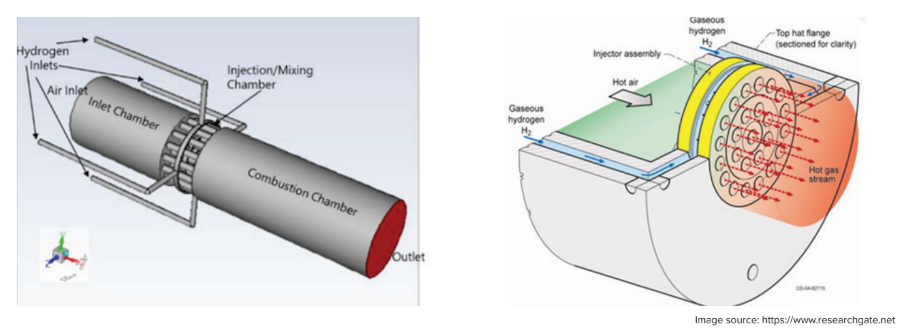
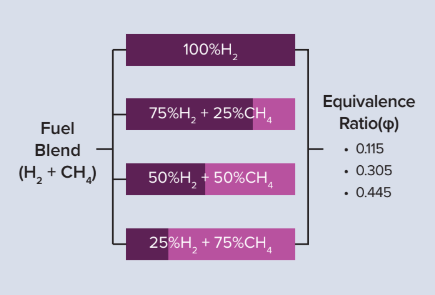
The PoC aimed to validate the viability of blended hydrogen fuel for aviation. The blending ratios ranged from 25% to 100% hydrogen fuel in mass composition, with varying proportions of methane. The exclusion of ammonia was a conscious decision due to its undesirable NOx emissions. Computational Fluid Dynamics (CFD) analysis was employed to observe the combustion behavior of different blends, with the results aligning well with NASA’s measured test data for a 100% H2 case. The findings were also presented at the ASME Turbo-Expo in June 2023, marking a significant milestone in our journey towards sustainable aviation fuel.
Hydrogen beyond the horizon
The success of the hydrogen pilot not only holds promise for aviation but also opens new vistas for its application in trains and cars, broadening the scope of sustainable fuel solutions. The journey towards sustainable aviation fuel is laden with both opportunities and challenges. Quest Global’s endeavors into blended hydrogen fuel have shed light on a promising path toward reducing the aviation sector’s carbon footprint. The PoC has showcased the potential and set the stage for further research and development to refine and optimize hydrogen fuel blends for commercial use. This journey, although demanding, underscores Quest Global’s unwavering commitment to building a sustainable future for all.











Senthil Prasad Mathiyalagan
Senthil Prasad Mathiyalagan is a Principal Engineer at Quest Global in Bangalore, where he leads innovative research in sustainable fuel technologies and computational fluid dynamics (CFD). With over two decades of engineering expertise, he has established himself as a thought leader in aerospace and energy solutions, particularly focusing on the intersection of CFD, photovoltaic systems, gas turbines, and HVAC technologies. At Quest Global, Senthil has been instrumental in pioneering research on methane-hydrogen fuel blends, contributing to significant breakthroughs in sustainable aviation fuel development. His work demonstrates how computational tools can accelerate environmental progress while maintaining operational efficiency across industries. Before joining Quest Global in 2019, Senthil spent over sixteen years as a Project Manager at Cyient, where he honed his expertise in managing complex engineering projects. His academic excellence is evidenced by his Master of Technology in Mechanical Engineering from Visvesvaraya Technological University, where he graduated with an A+ grade and earned recognition as a University Rank Holder.
Frequently Asked Questions
Blended hydrogen offers several strategic advantages in the pursuit of net-zero carbon emissions in aviation. It provides a high energy yield per unit mass due to its superior calorific value, making it suitable for long-range flights where fuel efficiency is crucial. This efficiency can significantly reduce the aviation industry’s carbon footprint, aligning with global sustainability goals. Additionally, hydrogen combustion primarily produces water vapor, a less harmful emission compared to traditional fossil fuels, enhancing the environmental benefits of its use.
Integrating hydrogen into existing aviation infrastructure presents several challenges, primarily due to its low density requiring more storage space and its need for high-pressure storage. Hydrogen’s interaction with metals demands advanced storage solutions, such as carbon-coated metals, to prevent leaks. Additionally, the current infrastructure needs adaptation to accommodate the specific requirements of hydrogen storage and distribution, including changes in fuel delivery systems and engine designs to handle its high volatility.
Quest Global is committed to maintaining compliance with industry standards like AS 9100 and ISO 27001 throughout its research and development processes. Our approach integrates advanced manufacturing technologies and rigorous testing to ensure that our solutions not only meet but exceed the necessary regulatory requirements. By prioritizing safety, efficiency, and reliability, we ensure that our innovative hydrogen fuel technologies align with global standards for quality and safety.
Quest Global’s approach focuses on pioneering research and development to optimize hydrogen fuel blends, particularly through innovative combustor designs that account for hydrogen’s high volatility and storage challenges. Our team conducts meticulous simulations and proof of concept (PoC) tests to validate the effectiveness of hydrogen blends in aviation. This unique focus on computational fluid dynamics (CFD) and the exclusion of ammonia due to its undesirable NOx emissions sets our methodology apart from conventional approaches.
Successful hydrogen PoC tests could revolutionize the aviation industry by demonstrating viable pathways to significantly reduce carbon emissions. These tests offer the potential to refine and optimize hydrogen fuel blends for commercial use, paving the way for broader adoption. This could lead to regulatory advancements, increased investments in hydrogen infrastructure, and a shift towards more sustainable practices within the industry. Furthermore, it could stimulate innovations in other transport sectors such as trains and cars, broadening the impact of hydrogen as a sustainable fuel.