




May 18, 2026

0 comments
Executive summary
The post-pandemic period was a threshold moment for model-based systems engineering. Across aerospace, automotive, medical devices, and energy, organizations that had been studying MBSE for years began committing to it in earnest, with major OEMs establishing dedicated MBSE leadership functions and publishing their adoption journeys through professional forums. Automotive manufacturers were already further along, driven by the escalating complexity of electrified and autonomous vehicle architectures. Industries that rarely move in concert were now converging on MBSE, signalling that the methodology had crossed from promising to operationally necessary. The global MBSE market, valued at approximately USD 2.85 billion in 2024, is projected to grow to USD 8.67 billion by 2033 at a compound annual growth rate of 13.2%, reflecting genuine capital commitment at program scale.
MBSE is not a tool upgrade or a standards compliance exercise. Pursued at its full potential, it becomes the infrastructure for an innovation ecosystem where OEMs and prime contractors, along with their entire supply networks, can query, configure, and collaborate through a shared machine-readable language, compressing product configuration cycles from years to weeks. INCOSE Vision 2035, the international systems engineering community’s long-range roadmap, describes exactly this end state. This article addresses the question I hear most often from engineering leaders who have been told MBSE is necessary yet cannot see the chain of events connecting that investment to a measurable business outcome. Until that chain is visible, implementation stalls and the potential remains theoretical.
The complexity problem that engineering can no longer outrun
Product complexity in engineering-intensive industries is growing faster than any organizational or process response has managed to match. INCOSE’s Vision 2035, published in 2022, documents this directly, observing that product complexity across engineering-intensive industries is expanding to the limits of our capacity to cope and that cost and effort are scaling disproportionately as programs strain against those limits. The practical consequences are familiar to anyone running a large program. Requirements contradict each other before they reach the build phase, interface definitions drift silently between subsystem teams, and change impact assessments consume weeks of senior engineering time only to miss something downstream.
The current way of doing engineering does not merely become more expensive as programs grow more complex, it becomes structurally unsustainable. Compounding this is the fact that engineering has been notably slower than sectors like banking, retail, or gaming to capture the gains available through automation and AI. The reason is structural. Engineering operates on PDFs, word-processed specifications, and manually maintained spreadsheets, and no amount of computing power can close the automation loop reliably across that kind of material. Shifting to model-based processes creates the machine-readable information layer that makes automation and AI genuinely usable. This is the foundational logic behind the US Department of Defense’s model-based procurement mandate and NASA’s drive to replace traditional document exchange with a digital thread of interconnected engineering models spanning the entire program lifecycle.
What the model-based innovation ecosystem means for your supply chain
The transformation goal in INCOSE Vision 2035 with the most direct commercial significance is the vision for model-based collaboration across organizational boundaries. The Vision describes a future state where integrated MBSE, simulation, and AI-assisted workflows enable system configurations to be composed from reusable model patterns, evaluated against performance requirements, and exchanged between organizations in a standard machine-readable language. In practical terms, a prime contractor could query its entire supplier network through that shared language and generate validated product configurations in days, a cycle that currently takes months under document-based processes. That compression in development timelines, even partially realized, would fundamentally reorder competitive positioning across the supply chain.
More than 200 INCOSE member organizations, from defense and aerospace OEMs to automotive manufacturers, energy companies, and leading universities, are actively contributing to the standards work that will underpin this ecosystem. The breadth of that membership signals that the model-based innovation ecosystem is converging on shared, interoperable foundations rather than on the internal standards of one dominant OEM. What this means in practice is that MBSE capability will increasingly separate suppliers who win consequential work from those who do not. The OEM that reaches the capability to query supplier model-based databases will increasingly structure procurement and collaboration around that capability. The supplier that has invested in genuinely standards-compliant MBSE practice, building real capability in model architecture and process integration alongside tool interoperability, will be part of that conversation. The supplier generating models to satisfy a contractual checkbox, without connecting those models to real engineering decisions, will find that the gap between compliance and capability has become a competitive liability.
Confronting the ROI question honestly
The ROI concern I encounter most often from engineering leaders is not really a question about numbers. What these leaders are searching for is a clear, traceable line from MBSE investment to a business outcome that shows up on a program budget or a competitive tender. What the industry has historically done poorly is show the mechanism connecting those inputs to measurable returns. Credible evidence exists, and it comes with important context about scope and implementation approach.
The most rigorously documented case study comes from the US Navy’s Submarine Warfare Federated Tactical Systems (SWFTS) program, which manages the common combat system across submarine fleets. A 2009 feasibility study projected a 13% reduction in the cost of processing a baseline change through MBSE applied to interface requirements management. The program transitioned over three years beginning in 2010, working with a system of over ten million source lines of code across ten submarine variants. A retrospective analysis published by Rogers and Mitchell in Systems Engineering in 2021 found that MBSE delivered higher quality products at significantly less cost per change, enabled the team to manage greater system-of-systems complexity within constant resources, and yielded 9% fewer total interface defects, with 37% fewer defects discovered during platform testing and an 18% shift of defect discovery to less costly laboratory integration testing. Independent estimates suggest that shift alone can reduce defect eradication costs by a factor of 1.6 to 4.
Near-term ROI from MBSE is most visible in bounded applications such as interface requirements management and change impact analysis, where the comparison between document-based and model-based processes is directly measurable. These program-level returns build the internal case for the next stage of adoption. The equally important dimension is the cost of inaction. When complexity doubles every four years and cost scales disproportionately, the document-based process that is adequate today becomes progressively more expensive to sustain, not through any degradation of the process itself but through the growing gap between what programs demand and what document-based coordination can deliver. The ROI calculation changes substantially when the trajectory of the status quo is honestly included alongside the upfront investment.
A maturity model that meets organizations where they are
The most consistent observation from many years of customer engagement is that organizations stall at MBSE through one of two patterns. They either try to move faster than their organizational culture and existing process infrastructure can absorb, or they treat tool deployment as transformation itself and discover too late that the models they have generated do not connect to anything real in the engineering work they were meant to support. Quest Global’s five-level MBSE maturity framework addresses this directly, weighting organizational culture and change readiness, processes and methodologies, and tools and applications as three equal dimensions. The equal weighting is deliberate. A technically excellent process deployed into an organization whose engineers have not been brought along will generate resistance that quietly defeats the initiative. An organizationally prepared team using a process that does not fit its design workflow will find that the models drift from the engineering decisions they were meant to inform.
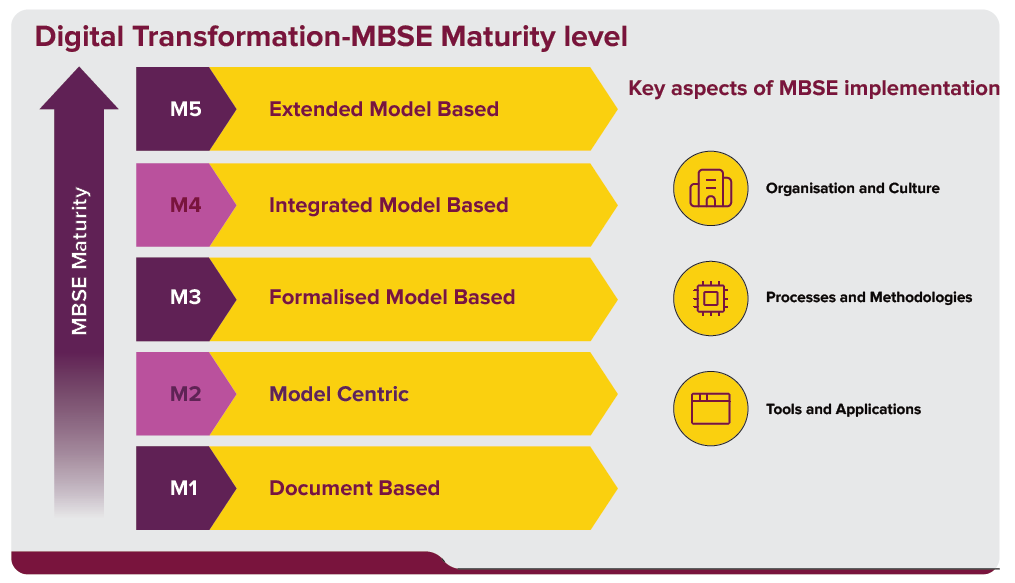
At maturity level one, the work is awareness and foundation, helping engineering leadership understand what MBSE demands organizationally and beginning the cultural groundwork that reduces resistance before it hardens. The approach starts with education, not tooling, since tools deployed without organizational readiness will mirror existing document structures in a more expensive format. At level two, model-based practices enter specific, bounded workflows with measurable outcomes. Level three integrates them across the design lifecycle with the process discipline to maintain model integrity as programs evolve. Level four extends MBSE practices into the supply chain, the foundational step toward the connected ecosystem the innovation vision describes. Level five is the state INCOSE Vision 2035 articulates. Models become the authoritative source for all engineering decisions, MBSE extends to suppliers and partners, AI-assisted workflows are embedded at enterprise scale, and the organization can query and configure across its supply network at a speed and precision that document-based processes cannot approach.
A systems engineering team in the Asia-Pacific region had been working to integrate MBSE into their design processes for over a year without clear direction. They understood the technology well enough but could not see where it connected to their existing lifecycle or how the models they would build would actually inform downstream engineering decisions. A four-hour workshop walked through their current design lifecycle in detail, identified the specific points where models would become the working basis for engineering decisions, and ran a live simulation to show what the redesigned workflow would look like in practice. At the end of the session, the team lead gave immediate approval to proceed. The structured maturity framework had given them something that a year of independent exploration had not, which was a visible, step-by-step path from where they were to where they needed to go.
What a structured implementation actually requires
Conversations about MBSE implementation tend to drift toward tool selection, and while tool choice matters, it is the last decision that should be made. The organizations that move successfully toward genuine MBSE maturity start with an honest assessment of where their processes, culture, and existing tooling sit against a structured maturity framework. From there, they identify the specific workflow elements where model-based approaches will replace document-based ones and define the transition process before any tooling decision is made. Quest Global develops customized processes for each customer engagement because the process suited to a large aerospace OEM looks fundamentally different from what a mid-tier defense supplier or an automotive tier one actually needs. A generic process applied uniformly produces an implementation that engineers experience as an obligation layered on top of work that has not actually changed, and that perception is what kills adoption regardless of how strongly leadership mandates it.
Organizational culture is the variable that most post-mortem analyses of failed MBSE efforts identify as the primary cause of failure. Engineers with two or three decades of successful document-based practice are rightly skeptical of change framed in terms of strategic vision with little grounding in operational impact. Awareness workshops at the start of customer engagements represent the first investment in the cultural readiness that determines whether the subsequent technical implementation will hold.
The window for early movers
The case for moving now on MBSE is grounded in two reinforcing pressures that are only intensifying. At the program level, organizations investing in genuine MBSE maturity today are building practitioner knowledge and process discipline that compound across successive programs, and that accumulated capability is not something a later entrant can recover quickly by purchasing the same tools. At the market level, OEM requirements and procurement mandates from bodies like the US Department of Defense are already creating participation thresholds that determine which suppliers are considered for the most consequential work. Both pressures point in the same direction, and for most engineering organizations the question has shifted from whether to begin MBSE adoption to how to begin without disrupting what already works. The product roadmaps ahead, carrying more software intelligence and supply chain interdependency than any previous generation of programs, will expose the limits of document-based coordination faster than most leadership teams currently anticipate.
Quest Global’s experience across aerospace, automotive, energy, and healthcare sectors has shown that a structured, maturity-guided approach resolves precisely that uncertainty, delivering demonstrable returns at each stage while protecting program continuity. The SWFTS data and the NASA timeline compression illustrate what is possible when MBSE moves from pilot to program scale. For organizations still weighing where to start, a maturity assessment against a structured framework turns an abstract ambition into a sequence of concrete, bounded steps.
Sources:
- INCOSE, Systems Engineering Vision 2035, International Council on Systems Engineering, 2022.
- Mitchell, S.W., “Transitioning the SWFTS Program Combat System Product Family from Traditional Document-Centric to Model-Based Systems Engineering,” Systems Engineering, vol. 17, no. 2, Spring 2014.
- Rogers, E.B. and Mitchell, S.W., “MBSE Delivers Significant Return on Investment in Evolutionary Development of Complex SoS,” Systems Engineering, vol. 24, no. 6, pp. 385-408, November 2021. DOI: 10.1002/sys.21592.
- Dataintelo, Model-Based Systems Engineering Market Research Report 2033, September 2025. Available at: www.dataintelo.com/report/modelbased-systems-engineering-market
- NASA, Digital Engineering Strategy, National Aeronautics and Space Administration, 2018.
- SEBoK Editorial Board, “Submarine Warfare Federated Tactical Systems,” Guide to the Systems Engineering Body of Knowledge (SEBoK), ver. 2.9, 2024. Available at: www.sebokwiki.org/wiki/Submarine_Warfare_Federated_Tactical_Systems








Vinay Paliya
Vinay Paliya is the MBSE Capability Leader at Quest Global, where he leads initiatives focused on advancing Model-Based Systems Engineering (MBSE) and digital engineering transformation across aerospace, defence, nuclear energy, automotive, and other complex engineering domains. Based in Derby, United Kingdom, he works at the intersection of systems engineering, process transformation, and capability development, helping organizations transition from document-centric engineering to scalable model-based approaches. With nearly three decades of experience spanning engineering design, program management, and digital transformation, Vinay has contributed to several flagship global programs, including Airbus A380 and long-range aircraft platforms, Rolls-Royce Trent and UltraFan engines, nuclear Small Modular Reactor (SMR) initiatives, Bombardier aerospace programs, and UK defence projects. His work focuses on enabling measurable engineering outcomes through improved traceability, validation, collaboration, and reduced design cycle times. An active contributor to the MBSE community, Vinay regularly engages with industry groups such as INCOSE and the IfSE MBSE Interest Group, with a strong focus on SysML v2 methodologies, digital thread integration, and scalable systems engineering practices.
MBSE, or Model-Based Systems Engineering, fundamentally alters how engineering-intensive industries tackle complexity by shifting from document-based to model-based processes. This transition allows for improved automation and AI integration, which enhances collaboration and reduces product configuration cycles from years to weeks. By creating a shared, machine-readable language, MBSE facilitates faster and more efficient communication across supply chains. This capability is critical for industries like aerospace and automotive, where rapid innovation and adaptation are key to maintaining a competitive edge.
The ROI from MBSE is often visible in specific areas like interface requirements management and change impact analysis. For example, the US Navy’s SWFTS program demonstrated significant cost savings and defect reductions by transitioning to MBSE. The key to measuring ROI lies in tracing MBSE investments to measurable business outcomes, such as reduced costs and improved product quality. Organizations must also consider the cost of inaction, as traditional document-based processes become less sustainable with growing complexity.
The current engineering landscape, with its increasing complexity and interconnectivity, presents a unique opportunity for early movers in MBSE. Organizations that invest in MBSE now will build a compounded knowledge base and process discipline that is difficult for latecomers to replicate. Additionally, procurement mandates and OEM requirements are establishing thresholds that favor MBSE-capable suppliers. Investing in MBSE ensures organizations remain competitive and positioned to take advantage of future market demands.
The INCOSE Vision 2035 outlines a future where model-based collaboration becomes standard across organizational boundaries. It emphasizes the need for integrated MBSE, simulation, and AI-assisted workflows, enabling the rapid assembly and validation of system configurations. This vision supports the development of a model-based innovation ecosystem, which allows for faster, more accurate product configurations. As a result, suppliers capable of leveraging these standards will be in a stronger position to compete for significant contracts.
Successful MBSE adoption hinges on aligning organizational culture, processes, and tools. Quest Global’s five-level MBSE maturity framework emphasizes the importance of cultural readiness and process integration. Organizations should avoid rushing tool deployment without proper preparation, as this can lead to resistance and ineffective implementation. A structured approach that begins with education and gradually integrates model-based practices is essential for overcoming these challenges.