



April 27, 2026

0 comments
Executive summary
Why do RBI programs still struggle with accurate damage mechanism screening despite decades of API standards and guidance? According to the American Institute of Chemical Engineers, unplanned downtime at refineries costs between $340,000 and $1.7 million per day for an average-sized fluid catalytic cracking unit. Yet many organizations still rely heavily on manual screening processes where accuracy depends almost entirely on individual engineers’ experience. Nearly 50% of integrity and inspection engineers in the oil and gas industry are 45 years or more of age and approaching retirement, creating a vacuum in engineering judgment built from decades of experience.
Engineers have access to API 571 and a solid grounding in corrosion theory but struggle to identify all potentially applicable damage mechanisms for given equipment and service combinations. A junior integrity engineer evaluating a crude unit heat exchanger operating at 340°C with carbon steel construction must determine which of 60-plus potential damage mechanisms actually apply. Sulfidation seems obvious, but what about high-temperature hydrogen attack when the temperature sits near the Nelson curve threshold? The experienced engineer down the hall would know immediately, but she’s reviewing assessments from three other junior engineers and planning next quarter’s turnaround inspection strategy. This scenario repeats across refineries, petrochemical plants, and production facilities where expert bandwidth cannot keep pace with assessment demands.
Organizations implementing GenAI-powered Expert-In-The-Loop (EITL) screening report 40-50% faster assessment completion, 60% fewer review cycles, and 8-10 hours per week reclaimed by senior engineers for strategic work. These systems make expert reasoning accessible to every engineer at the moment they need it, accelerating how early-career engineers develop proficiency while allowing senior professionals to focus on genuinely complex problems. Organizational intelligence gets captured systematically before expertise walks out the door.
API 571 is a gold standard that’s hard to apply in practice
API 571 and complementary standards like API 939-C for sulfidation corrosion, API 939-D for ethanol stress corrosion cracking, and API 751 for corrosion in alkylation units provide frameworks rather than formulas. When process conditions approach threshold values, when multiple mechanisms interact, or when site-specific operating history shows non-standard behaviors, judgment becomes essential. A senior corrosion engineer draws on pattern recognition built from years of observing how theoretical damage mechanisms manifest in actual equipment.
One engineer describes the challenge this way. “I look at equipment data and immediately know this crude slate will be more aggressive than the sulfur number suggests, or that we’ll see velocity effects in this configuration. That knowledge came from a decade of reviewing inspection results. How do I transfer that to someone with six months of experience?” Junior engineers can access the standards but struggle to apply them to specific contexts. Real-world conditions rarely align perfectly with threshold values like 260°C for sulfidation or 590°C for carburization. Site-specific operating history often determines which mechanisms actually manifest. Missed mechanisms cascade into gaps within integrity operating windows (IOWs), directly affecting safe, profitable operations.
When engineers miss critical mechanisms, the consequences extend far beyond the assessment itself. Those gaps create flaws in the integrity operating windows that define how safely and productively assets can run. The crux lies in translating tacit expertise, built across thousands of observations, into consistent screening decisions for early-career engineers.
How screening decisions shape what assets can produce
Damage mechanism screening goes beyond guiding inspection methods and frequencies. The mechanisms identified directly define integrity operating windows, which establish the process parameter boundaries where equipment can run safely. When screening identifies sulfidation as relevant, the corresponding IOW must include temperature and sulfur content limits that prevent unacceptable corrosion rates. Missed mechanisms create blind spots in IOWs; over-conservative calls can constrain throughput unnecessarily.
The difference between accurate and overly conservative screening shows up directly as available throughput. IOWs feed into process operation procedures, alarm setpoints, and management of change protocols. When process engineers propose running conditions outside established windows, that triggers integrity reviews and potentially expensive risk assessments. Poor screening creates compounding impacts across inspection planning, maintenance scheduling, and operational decision-making. Getting screening right matters for both safety and economic performance, yet achieving that accuracy remains challenging when traditional approaches struggle to scale expert judgment across growing assessment volumes. Screening accuracy directly influences safety, turnaround planning, and economic performance.
The GenAI difference in screening
Traditional automation relies on decision trees that map parameters to mechanisms, but screening demands contextual reasoning and explainability. Determining which mechanisms present the highest risk under specific conditions and explaining why some matter more than others requires judgment. The process demands recognizing when standard guidelines need adjustment based on operating experience while ensuring accountability for recommendations affecting safety-critical equipment.
Our experience shows that retrieval-augmented generation can surface the right sections of API 571 and related standards in context, producing transparent, source-linked explanations that mirror expert reasoning. Engineers can interrogate scenarios, compare mitigations, and understand trade-offs, with human judgment retained for safety-critical calls.
Over time, the GenAI component grows more capable with each interaction, continuously refining how it interprets queries and structures responses through patterns learned from actual use. Human judgment remains central to final decisions on safety-critical equipment, while the architectural approach transforms how organizations deploy expertise at scale.
Building AI that learns like an engineer
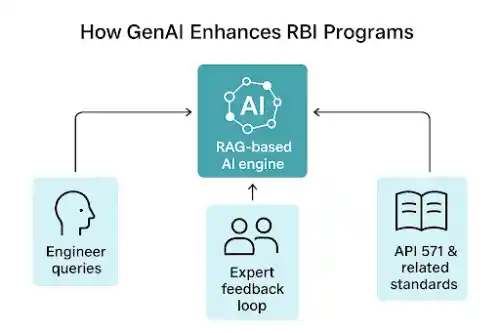
Quest Global’s damage mechanism screener architecture centers on a RAG-based virtual SME bot that interacts with API 571 and related standards as a dynamic knowledge base. When an engineer queries about sulfidation risks in a crude unit, the system retrieves relevant sections about temperature thresholds, material susceptibilities, and hydrogen sulfide concentration effects, then synthesizes this information into contextual explanations addressing the specific equipment and operating conditions. Engineers can ask follow-up questions about mitigation approaches or how conditions change with different crude slates. The conversation builds understanding rather than simply providing a checklist to follow.
The continuous improvement architecture operates through AI self-training and expert feedback loops where senior engineer modifications become institutional knowledge. When a senior engineer adds a mechanism the system didn’t suggest or removes one that seems implausible under site-specific conditions, that action trains the AI for similar future scenarios. Analysis across hundreds of assessments reveals systematic gaps that would remain invisible in individual reviews. Multiple layers of expert review built into the equipment strategy process maintain decision accountability while generating feedback that makes the AI progressively more accurate. This creates a system that becomes smarter with each use while preserving human accountability. The real-world impact of this approach shows up clearly in deployment results.
The numbers behind AI-powered screening
Quest Global’s deployments across refining, petrochemical, and upstream operations show assessment completion times dropping 40-50% as engineers become comfortable with the system. First-pass accuracy rates improve substantially, with one refinery measuring a 60% reduction in assessment review cycles over the first year. Senior engineers report reallocating 8-10 hours per week from review work to higher-value activities like failure investigations and strategic planning.
- Multiple clients reported that early-career engineers felt more confident with expert-level guidance available at the moment they needed it, addressing chronic anxiety about missing critical mechanisms.
- Senior engineers appreciated being freed from repetitive review work.
- Integration with IOW development and inspection strategy planning multiplied the impact such that engineers see how screening decisions ripple across the entire integrity program.
Treating the solution as capability infrastructure, not just productivity software, unlocks compounding value over time. The urgency for this kind of capability-building infrastructure has never been greater.
Preserving knowledge in the age of retiring experts
With nearly 50% of the current oil and gas workforce over age 45 and many expected to retire in the coming years, intelligent screening systems built on expert-in-the-loop architectures are becoming essential within RBI programs. The challenge cannot be solved through hiring and training alone. Organizations now face a choice—
- Some will adopt tools that automate screening and provide lists of mechanisms, gaining efficiency but missing the capability-building opportunity.
- Others will implement GenAI-powered systems that amplify expertise and make senior engineer reasoning accessible across teams through AI self-training and expert feedback loops that capture institutional knowledge before it walks out the door.
The demographic reality means a significant portion of the workforce approaches retirement within the next several years, taking decades of accumulated judgment with them. AI systems that capture the reasoning behind expert decisions rather than just the decisions themselves create organizational intelligence that outlasts individual tenures. Every engineer gains access to expert-level guidance at the moment they need it, regardless of time zones or workload. This capability multiplication delivers better decisions, faster engineer development, improved operational flexibility, and reduced dependence on scarce expertise. The knowledge preservation imperative has never been more urgent, and the technology to address it has never been more capable. The question now is how organizations will act on this opportunity.
Using this moment to rethink expertise
Screening remains one of the crucial points in the asset integrity workflow where knowledge and data truly intersect. Organizations that use this step to build collective intelligence gain enduring advantages through better decisions, faster development of young engineers, and knowledge that continues beyond individual careers.
Asset integrity leaders should position GenAI as a capability-building platform rather than simple automation. Embedding GenAI into RBI workflows amplifies expertise across teams, accelerates engineer development, and preserves institutional knowledge, ensuring resilience and operational excellence at scale.
Key takeaways
- The urgency: Refinery downtime costs $340,000 to $1.7 million daily. Nearly 50% of the oil and gas workforce is over 45, approaching retirement.
- Proven results: Quest Global’s GenAI screening delivers 40-50% faster assessments, 60% fewer review cycles, and 8-10 hours weekly reclaimed for strategic work.
- How it works: Retrieval-augmented generation makes API 571 conversational with AI self-training from expert feedback loops.
- The impact: Early-career engineers develop proficiency faster, screening accuracy improves operational flexibility through better IOWs, and organizations preserve institutional knowledge.
Workforce aging and retirement statistics: U.S. Bureau of Labor Statistics (2024) and Engineering Construction Industry Training Board (ECITB), “Workforce Census Sectoral Report” (March 2025):
https://www.learntodrill.com/post/labor-shortage-in-oil-gas
https://www.energyvoice.com/oilandgas/567024/young-people-unlikely-to-replace-retiring-oil-workers/







Anshuman Sehgal
Anshuman Sehgal is a Chief Engineer at Quest Global in Bengaluru, with over 21 years of experience in the oil and gas industry. He specializes in asset integrity, static equipment design, fitness for service, and risk-based inspection. His experience spans erection, commissioning, maintenance, inspection, and reliability of both rotary and static equipment across refinery, petrochemical, and offshore operations. Before joining Quest Global, Anshuman held technical and leadership roles at Reliance Industries Limited and Yanbu National Petrochemical Company, where he worked on inspection strategy, asset reliability, turnaround planning, and equipment maintenance. He has also contributed to standards development through the Bureau of Indian Standards committee for online leak sealing systems. At Quest Global, he focuses on technical quality, fitness-for-service assessments, capability development, and mentoring engineering teams.
Frequently Asked Questions
GenAI-powered Expert-In-The-Loop (EITL) systems significantly enhance damage mechanism screening by making expert reasoning accessible to all engineers. These systems streamline the screening process, allowing for 40–50% faster assessment completion and reducing review cycles by 60%. This integration helps capture organizational intelligence, which is crucial as nearly half of the workforce approaches retirement. By automating routine tasks, senior engineers can focus on complex problems, ensuring that critical expertise is preserved and disseminated throughout the organization.
Unlike traditional automation, which relies on static decision trees, GenAI leverages retrieval-augmented generation to provide contextual reasoning and explainability. This approach allows engineers to explore scenarios, compare mitigations, and understand trade-offs, retaining human judgment for safety-critical decisions. GenAI systems are designed to learn from interactions, continuously improving their accuracy and reliability, which helps organizations deploy expertise at scale while maintaining accountability.
Integrating GenAI into Risk-Based Inspection (RBI) workflows enhances operational flexibility by improving screening accuracy and reducing the dependency on senior engineers for routine assessments. This integration allows for more precise IOWs, facilitating better operational decisions and optimizing throughput. By treating GenAI as a capability-building platform rather than mere productivity software, organizations can achieve compounding value over time, maintaining resilience and excellence at scale.
While API 571 and related standards provide a robust framework, they often fall short in practice due to the complexity and variability of site-specific conditions. Engineers frequently encounter situations where theoretical thresholds do not align with actual operating conditions, requiring significant judgment and experience to interpret. This is particularly challenging for junior engineers who may lack the necessary experience to make these nuanced decisions, leading to potential gaps in Integrity Operating Windows (IOWs) and affecting asset safety and performance.
With a significant portion of the oil and gas workforce nearing retirement, GenAI systems play a critical role in preserving valuable engineering judgment. These systems capture the reasoning behind expert decisions, ensuring that institutional knowledge is retained and accessible to all engineers. This capability is crucial not only for maintaining operational excellence but also for the rapid development of early-career engineers, who benefit from expert-level guidance during critical decision-making processes.